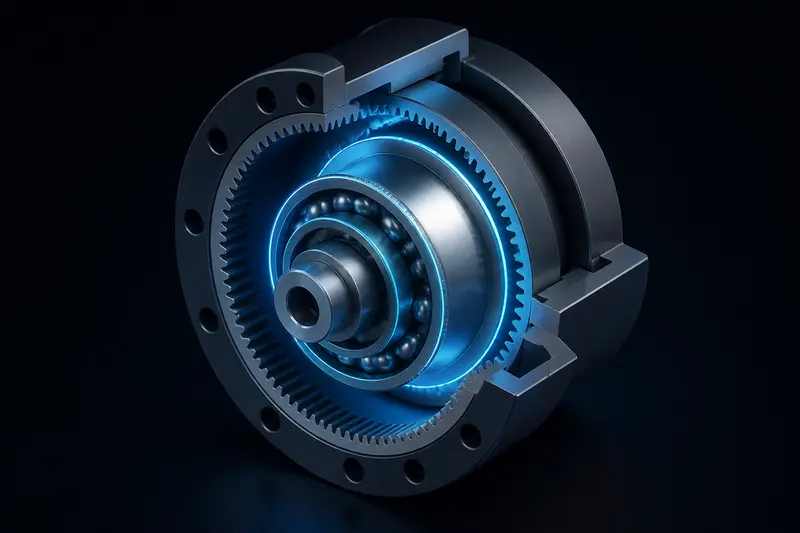
Almost every rotary robot joint needs a gear reduction. A brushless motor spins fast and produces relatively little torque; a robot arm joint needs the opposite: low speed and high torque, delivered without slop. The question of harmonic drive vs planetary gearbox comes up constantly when picking that reduction, and the two technologies solve the problem in fundamentally different ways. This article walks through how each works mechanically, then compares them on the properties that actually matter for a joint design: backlash, torsional stiffness, torque density, efficiency, and cost.
How a Planetary Gearbox Works
A planetary (epicyclic) gearbox has three main elements: a central sun gear driven by the motor, several planet gears that mesh with both the sun and an outer ring gear, and a carrier that holds the planets and rotates with them. In the most common robotics configuration, the ring gear is fixed to the housing, the sun gear is the input, and the carrier is the output.
The reduction ratio for this configuration is:
ratio = 1 + (teeth on ring gear / teeth on sun gear)
A single planetary stage typically gives a ratio between 3:1 and 10:1. Multiple stages can be stacked in series to reach higher ratios, at the cost of extra length and some efficiency loss per stage. Because load is shared across three or more planet gears simultaneously, planetary gearboxes handle high torque in a compact diameter, which is why they show up in everything from cordless drills to robot wheel hubs.
How a Harmonic Drive Works
A harmonic drive, also called a strain wave gear, uses a completely different principle: elastic deformation instead of rigid meshing at a single point. It has three components: a rigid circular spline with internal teeth, a flexspline (a thin, flexible cup with external teeth, slightly fewer teeth than the circular spline), and an elliptical wave generator that fits inside the flexspline and forces it to flex into an oval shape.
As the wave generator rotates, it pushes the flexspline's teeth into and out of mesh with the circular spline at two opposite points. Because the flexspline has fewer teeth than the circular spline, typically two fewer, each full rotation of the wave generator advances the flexspline by only that small tooth difference. The reduction ratio is:
ratio = flexspline teeth / (circular spline teeth - flexspline teeth)
This is why a single harmonic drive stage can reach ratios of 50:1 to 160:1 in one compact package, something a planetary gearbox would need multiple stages to achieve. It also explains the defining harmonic drive characteristic: because many teeth are engaged simultaneously (roughly 30 percent of all teeth at any instant, spread over the two flex zones), backlash is extremely low, often near zero in precision-ground units.
Backlash and Positioning Accuracy
Backlash, the small amount of free play before a reversing gear train re-engages, is the single biggest reason harmonic drives dominate in precision robot joints and industrial arm wrists. A well-made harmonic drive has backlash under 1 arcminute, sometimes zero-backlash by design. A single-stage planetary gearbox, even a good one, typically has 3 to 15 arcminutes of backlash depending on manufacturing tolerance and preload.
For a joint doing fine manipulation, like a surgical robot or a SCARA arm's wrist, that difference compounds directly into end-effector positioning error. For a mobile robot's drive wheel, where backlash mostly shows up as a small dead zone during direction reversal, it matters far less.
Torsional Stiffness
This is where the tradeoff flips. Torsional stiffness measures how much a joint twists under load before delivering motion, and it is critical for control loop stability and repeatability under external force. Planetary gearboxes are torsionally stiffer than harmonic drives of comparable size, because the load path is through rigid, thick-section gear teeth rather than a thin flexing cup.
A harmonic drive's flexspline is, by design, a thin-walled flexible component. Under high torque it winds up elastically more than a planetary stage would, which shows up as compliance in the joint. Robot designers who need both low backlash and high stiffness, such as for legged robot hip joints under impact loads, sometimes end up choosing a planetary or cycloidal gearbox instead, accepting more backlash in exchange for stiffness.
Torque Density, Size, and Weight
Harmonic drives generally win on torque density for a given package diameter, because the high single-stage ratio avoids the added mass and length of stacking planetary stages. This is a major reason harmonic drives are standard in collaborative arm joints, where every joint's weight is carried by every joint upstream of it, and shaving grams matters.
Planetary gearboxes, however, tend to be more efficient at transmitting very high raw torque relative to their cost, since the load is shared across multiple rigid gear meshes rather than concentrated in a flexing thin-wall component. For a high-torque, lower-ratio application such as a wheel hub or a linear actuator drive, a planetary stage is often the more robust and cheaper choice.
Efficiency
Planetary gearboxes typically run at 90 to 97 percent efficiency per stage, since the losses are just standard gear mesh friction. Harmonic drives run lower, typically 65 to 90 percent depending on ratio, temperature, and speed, because the flexspline undergoes continuous elastic deformation on every revolution, and that flexing dissipates energy as heat. At high ratios and low speed this is usually acceptable, but it does mean harmonic drive joints need proper thermal management in continuous-duty applications, and motor sizing should budget for this loss.
Cost and Availability
Precision harmonic drives from established manufacturers are expensive, often several hundred to well over a thousand dollars for a single unit, because the flexspline requires precise heat treatment to survive millions of flex cycles without fatigue failure. Planetary gearboxes span a much wider price range: inexpensive plastic-gear units for hobby projects, up to precision ground-steel planetary stages that rival harmonic drive pricing. For a budget-constrained build like a hobbyist arm, a planetary gearbox or even a simple worm gear is usually the practical starting point, with a harmonic drive reserved for joints where backlash genuinely limits the design.
Which One to Choose
- Pick a harmonic drive when backlash and compact single-stage high ratio matter most: robot arm joints, wrists, precision positioning stages, collaborative robots.
- Pick a planetary gearbox when torsional stiffness, high raw torque, high efficiency, or cost matter most: wheel hubs, linear actuators, legged robot hips, high-load lower-precision joints.
- Consider a cycloidal drive as a middle ground if you need low backlash and high shock load tolerance and can accept more size and slightly more vibration than a harmonic drive.
Neither technology is universally better. The right choice depends on which property the joint actually needs: near-zero backlash for precision, or torsional stiffness and efficiency for raw load handling. Matching the gearbox to the joint's actual duty cycle, not just its torque requirement, is what separates a robust design from one that fights its own drivetrain.
Building or studying robotics?
Arcbotix publishes practical guides on robotics engineering, control systems and real-world builds. Explore more articles on the blog.