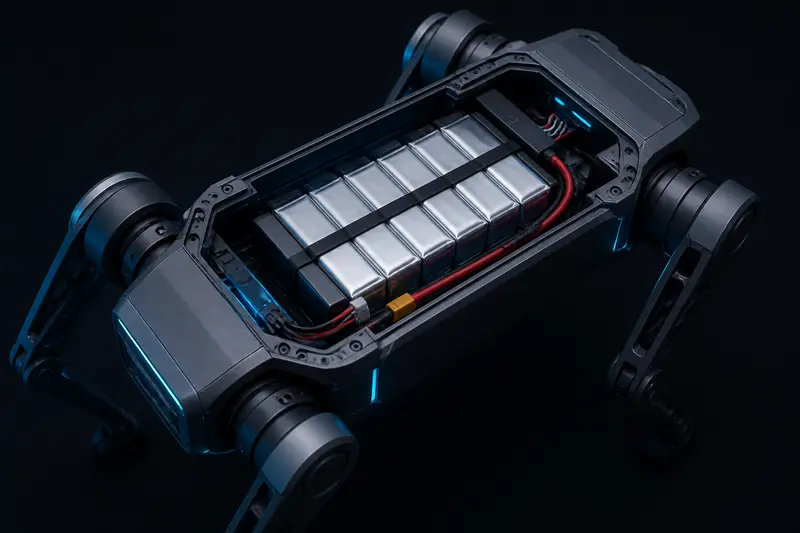
Choosing a battery for a quadruped robot is a different problem than choosing one for a wheeled rover or a drone. Legged locomotion produces sharp, repeating current spikes every time a leg pushes off the ground, and the battery has to sit somewhere on a chassis that is already packed with actuators, gearboxes, and a compute board. Get the sizing wrong and you either run out of torque mid-stride, cook your cells, or end up with a robot that walks for four minutes before it needs a recharge. The actuator choice you made earlier, see servo vs stepper vs BLDC motor for robotics, largely determines the current profile this guide is sizing for.
This guide walks through the four numbers that actually matter when choosing a battery for a quadruped robot: voltage, capacity, continuous discharge rate, and peak discharge rate. It also covers chemistry tradeoffs and mounting, which affect a legged robot more than most other robot types because the battery is part of the body's mass distribution.
Step 1: Match Voltage to Your Motor Drivers
Start with voltage, because it is set by your actuators, not by how long you want to run. Most hobby and small-research quadrupeds use brushless motors with integrated drivers (like MIT Mini Cheetah-style modules) or geared servos, and each has a rated voltage window.
- BLDC actuator modules: commonly run at 24V (6S LiPo) or 48V (12S or two 6S packs in series), depending on the torque density needed at the hip and knee joints.
- Smart servos (Dynamixel-class): typically 12V to 24V, so 3S to 6S LiPo covers most builds.
- Small hobby servos: 6V to 8.4V, meaning 2S LiPo with a buck converter, since running servos directly off a higher-voltage pack will destroy them.
Pick the pack voltage that lands your motor drivers in the middle of their rated range, not at the top. Running at the extreme edge of a driver's voltage window leaves no margin when the pack is freshly charged and sitting 0.5 to 1V above nominal.
Step 2: Estimate Continuous Current Draw
A quadruped's continuous current draw at a steady trot is the sum of what each leg's motors pull to support body weight and swing the leg forward, plus the compute board and sensors. As a rough field estimate, a small research-scale quadruped in the 5 to 15 kg range typically draws 15 to 40A continuous at a walking gait, with 12 motors (3 per leg) sharing that load unevenly, hip and knee motors usually pull more than abduction motors.
If you don't have motor current curves, a practical shortcut is to bench-test one leg on a stand, log current with a USB power meter while running your gait controller in place, and multiply by four with a 20 percent margin for imperfect leg synchronization.
Step 3: Size Capacity for Your Runtime Target
Once you know continuous draw, capacity in amp-hours follows directly:
Capacity (Ah) = Continuous Draw (A) x Target Runtime (h) / Usable FractionThe usable fraction accounts for the fact that you should not discharge LiPo cells below about 3.3V per cell in normal use, which leaves roughly 80 to 85 percent of rated capacity usable before you hit that cutoff. For a robot drawing 25A continuous with a 15-minute runtime target:
Capacity = 25A x 0.25h / 0.8 = 7.8 AhRound up to a common pack size, in this case a 8Ah or 10Ah 6S LiPo. Note that runtime targets for quadrupeds are usually short by mobile-robot standards, 10 to 25 minutes of active walking is normal for a mid-size research platform, because the legs are far less efficient than wheels at converting battery energy into forward motion.
Step 4: Check Discharge Rate Against Peak Torque Events
This is the step that trips people up on legged robots specifically. A quadruped's current draw is not flat, it spikes sharply during stance phase when a leg absorbs body weight after a step, and again during any jump or stumble recovery. These spikes can be 2 to 4 times the continuous average for short bursts of 50 to 150 milliseconds.
LiPo packs are rated with a continuous C-rating and sometimes a separate burst rating. The C-rating multiplied by capacity in amp-hours gives maximum current:
Max Current (A) = C-rating x Capacity (Ah)For an 8Ah pack rated at 25C continuous, that's 200A continuous capability, comfortably above a 25A average draw with headroom for spikes. Undersizing this margin is a common mistake: a pack that looks adequate for continuous draw but has a low C-rating will sag in voltage during every stance-phase spike, which can trigger brownouts in your motor controllers or trip low-voltage cutoffs mid-gait. When in doubt, size the C-rating for at least 3x your continuous draw, not just the continuous draw itself.
Chemistry: LiPo vs Li-ion for Legged Robots
LiPo (lithium polymer) dominates hobby and research quadrupeds because of its high discharge rate per unit weight, which matches the spiky current profile described above. Li-ion cells (like 18650 or 21700 format) offer higher energy density and lower cost per watt-hour, but most off-the-shelf Li-ion packs have lower continuous C-ratings, often 2C to 5C versus 15C to 35C for LiPo. Li-ion can still work if you oversize capacity well beyond your runtime target purely to get enough parallel cells for current capability, but this adds weight that a legged robot has to carry and accelerate with every step.
LiFePO4 (lithium iron phosphate) is worth considering if safety and cycle life matter more than weight, it is far more tolerant of abuse and won't thermal-runaway as easily as standard LiPo, but at roughly two-thirds the energy density, expect a real hit to runtime or a heavier pack for the same capacity.
Mounting and Mass Distribution
Unlike a wheeled rover, where battery placement mostly affects tipping stability, a quadruped's battery position affects the inertia the legs have to swing against with every stride. Mounting the pack low and centered in the torso, close to the robot's center of mass, keeps the body's roll and pitch inertia manageable for the balance controller. Mounting it high or off to one side makes the whole gait controller work harder to reject disturbances, even if the total mass is identical.
If your chassis design allows it, splitting one large pack into two smaller packs mounted symmetrically fore and aft, or left and right, of center can improve mass balance without changing total capacity. This is a common pattern on quadrupeds that also carry a front-facing sensor payload, since it offsets the payload's own contribution to inertia.
A Worked Example
Consider a 10 kg quadruped with 12 BLDC actuator modules rated at 24V, drawing an estimated 28A continuous at a trot with spikes to 90A during stance phase, and a target runtime of 20 minutes:
- Voltage: 6S LiPo (22.2V nominal, 25.2V full charge) matches the 24V driver window.
- Capacity: 28A x 0.333h / 0.8 = 11.7 Ah, round up to a 12Ah pack.
- Discharge rate: need at least 90A burst, so a 12Ah pack needs a C-rating of at least 7.5C for the burst case alone; picking a 20C-rated pack (240A max) gives comfortable margin for continuous draw and repeated spikes without voltage sag.
- Mounting: centered low in the torso, split into two 6Ah 6S packs if the chassis has separate front and rear bays.
This same process, voltage first, then continuous draw, then capacity, then discharge rate, generalizes to any quadruped build regardless of size. The numbers change, the order of operations does not.
The single most common battery-sizing mistake on legged robots is treating capacity as the whole story and ignoring discharge rate. A pack with plenty of amp-hours but a low C-rating will still brown out your motor controllers during a hard stance-phase spike.
Once you've settled on pack voltage and capacity, the same current numbers feed directly into wiring gauge and connector selection for the rest of the power system, see power budgeting for mobile robots for how to carry peak and average current through to wire gauge and fuse sizing, so it's worth logging your measured continuous and peak draw values before you finalize the build.
Building or studying robotics?
Arcbotix publishes practical guides on robotics engineering, control systems and real-world builds. Explore more articles on the blog.