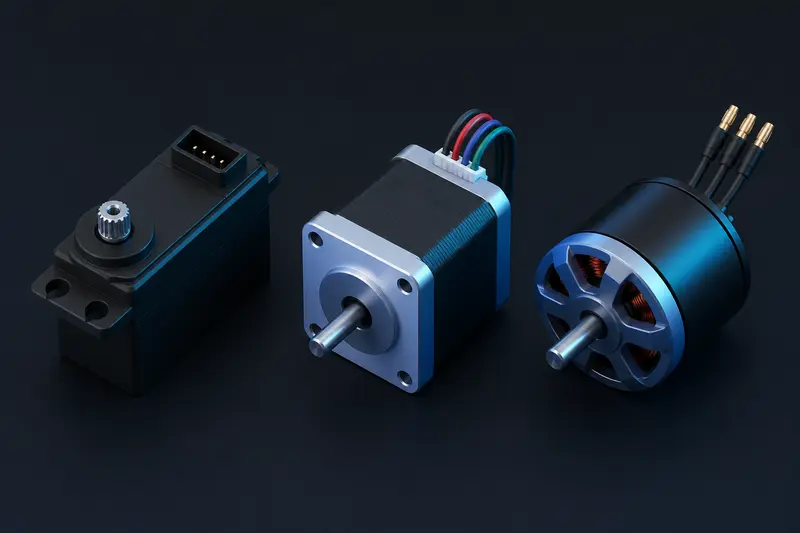
Servo vs Stepper vs BLDC Motor for Robotics: What Actually Matters
Picking the right actuator is one of the first hard decisions in any robotics build, and it shapes everything downstream: your power budget, your control loop, and how precise your motion can be. The servo vs stepper vs BLDC motor for robotics question does not have one universal answer. Each motor type trades off torque density, positional accuracy, cost, and control complexity differently, and the right choice depends on what the joint or wheel actually needs to do.
This article breaks down how each motor type works, where it excels, and where it falls short, so you can match the actuator to the job instead of defaulting to whatever is cheapest on a parts list.
Hobby Servos: Simple, Self-Contained, Limited
A hobby servo (the kind used in RC cars and small arms) bundles a DC motor, a gear reduction, a potentiometer for position feedback, and a small control board into one sealed unit. You send it a PWM pulse, typically between 1 and 2 milliseconds wide, and the servo's internal electronics drive the motor until the potentiometer reports the commanded angle.
Strengths
- Closed-loop position control is already built in, so you do not need to write your own feedback loop.
- Cheap and widely available, from small 9g servos to higher-torque 20kg-cm units.
- Simple three-wire interface: power, ground, and signal.
Weaknesses
- Limited rotation range, usually 180 to 270 degrees, which rules out continuous rotation joints without modification.
- Plastic gear trains in cheaper units strip under sustained load.
- Coarse resolution: the potentiometer feedback is analog and noisy, so positional accuracy rarely beats plus or minus 1 degree.
- No good way to read back velocity or current, which matters if you want compliant or force-aware control.
Hobby servos are the right call for a first robotic arm, a pan-tilt camera mount, or any joint where “close enough” positioning at low cost matters more than precision or continuous rotation.
Stepper Motors: Precise, Open-Loop by Default
A stepper motor divides a full rotation into a fixed number of discrete steps, commonly 200 steps per revolution (1.8 degrees per step) for NEMA-standard motors, or 400 with half-stepping drivers. You command it by sending step pulses to a driver (such as an A4988 or TMC2209), and the motor moves exactly one step per pulse, assuming it does not lose synchronization.
Strengths
- Excellent positional accuracy without any feedback sensor, since each step corresponds to a known, fixed angle.
- Holds position at zero speed with full torque, useful for a joint that needs to resist gravity while idle.
- Simple digital step/direction interface, and drivers are cheap and well documented.
- Micro-stepping drivers can subdivide each step further for smoother motion, though this trades off some torque.
Weaknesses
- Open-loop by default: if the motor is asked to move faster than it can physically follow, it skips steps and silently loses position. This is the single biggest failure mode in stepper-driven robots.
- Torque drops sharply as speed increases, so steppers are a poor fit for fast, high-speed joints.
- Inefficient at holding torque compared to their size and weight; they draw current continuously even when stationary.
- Adding an encoder for closed-loop stepper control (sometimes called a “closed-loop stepper” or using a driver like the TMC5160 with stallguard) adds cost and complexity, partially erasing the simplicity advantage.
Steppers are the standard choice for 3D printer axes, CNC-style linear stages, and any robot joint where speed is low to moderate but positional repeatability matters more than raw torque density. If you are working through inverse kinematics for a small arm, a stepper-driven joint gives you predictable angles to feed into your IK solver without needing to model slip.
BLDC Motors: High Torque Density, Real Control Effort
Brushless DC (BLDC) motors use electronically commutated coils and permanent magnets, avoiding the brushes and mechanical wear of brushed DC motors. They come in two common winding layouts, trapezoidal (driven with simple six-step commutation, sometimes called BLDC control) and sinusoidal (driven with field-oriented control, or FOC, for smoother torque output).
Strengths
- Best power-to-weight and torque-to-weight ratio of the three motor types, which matters enormously for legged robots and drones where every gram of actuator mass has to be carried by other actuators.
- Very high efficiency, often above 85 percent, with minimal heat generation compared to a stepper drawing constant current.
- Smooth torque output at a wide range of speeds when driven with FOC, with no step-loss failure mode.
- Can be run as direct-drive actuators (no gearbox) in designs like quasi-direct-drive quadruped legs, since BLDC motors can be wound for high torque at low RPM. When a gearbox is used instead, the choice between a harmonic drive and a planetary gearbox shapes the joint's backlash and stiffness just as much as the motor choice does.
Weaknesses
- Requires a dedicated electronic speed controller (ESC) or FOC driver, and closed-loop position control needs an external encoder or hall-effect sensors plus a real control loop, often running a PID or cascaded velocity/position loop, similar in structure to the loops covered in PID controller tuning for robotic arms.
- Higher upfront cost and more complex wiring: three phase wires plus sensor wiring, versus a stepper's four wires or a servo's three.
- Tuning FOC current loops and velocity loops is a real engineering task, not a plug-and-play setup.
BLDC motors are the right choice when torque density, efficiency, or high-speed smooth motion outweighs the extra control complexity: drone propulsion, quadruped leg actuators, high-performance arm joints, and wheeled robot drive motors.
A Practical Decision Framework
Use this as a starting filter rather than a strict rule:
- If the joint just needs to hit an angle and hold it under light load, and budget is tight, use a hobby servo.
- If the joint needs precise, repeatable positioning at low to moderate speed and you want to avoid writing a feedback control loop, use a stepper with a good driver, and add stall detection if backlash-free precision is critical.
- If the joint needs high torque density, high speed, or smooth continuous motion, and you are prepared to implement or tune a real control loop, use a BLDC motor with FOC.
Actuator choice is a system decision, not a component decision: it determines your control loop design, your power budget, and how much software work is ahead of you before the joint moves reliably.
Power and Driver Considerations
Beyond the motor itself, check driver current ratings against stall current, not just running current. Steppers draw their rated current continuously, even when stationary, which affects your power budget calculations for a battery-powered robot, see choosing a battery for a quadruped robot for how continuous and peak current draw translate into pack sizing. BLDC motors and their ESCs need current ratings sized for peak acceleration current, which can be several times the steady-state running current. Hobby servos are simplest here since the current draw scales roughly with load, but cheap servos can still brown out a shared power rail under stall conditions, so give servo-heavy designs a separate, well-regulated power rail from the logic supply.
Conclusion
There is no universally best actuator. A hobby servo gets a low-cost arm moving with minimal setup. A stepper gives you accurate, repeatable positioning without writing a feedback loop, as long as you respect its torque-speed curve and watch for step loss. A BLDC motor delivers the torque density and efficiency serious high-performance robots need, at the cost of a real control loop and more complex driver electronics. Match the actuator to the joint's actual torque, speed, and precision requirements, and the rest of the drivetrain design gets much easier.
Building or studying robotics?
Arcbotix publishes practical guides on robotics engineering, control systems and real-world builds. Explore more articles on the blog.